
Why This Story Matters
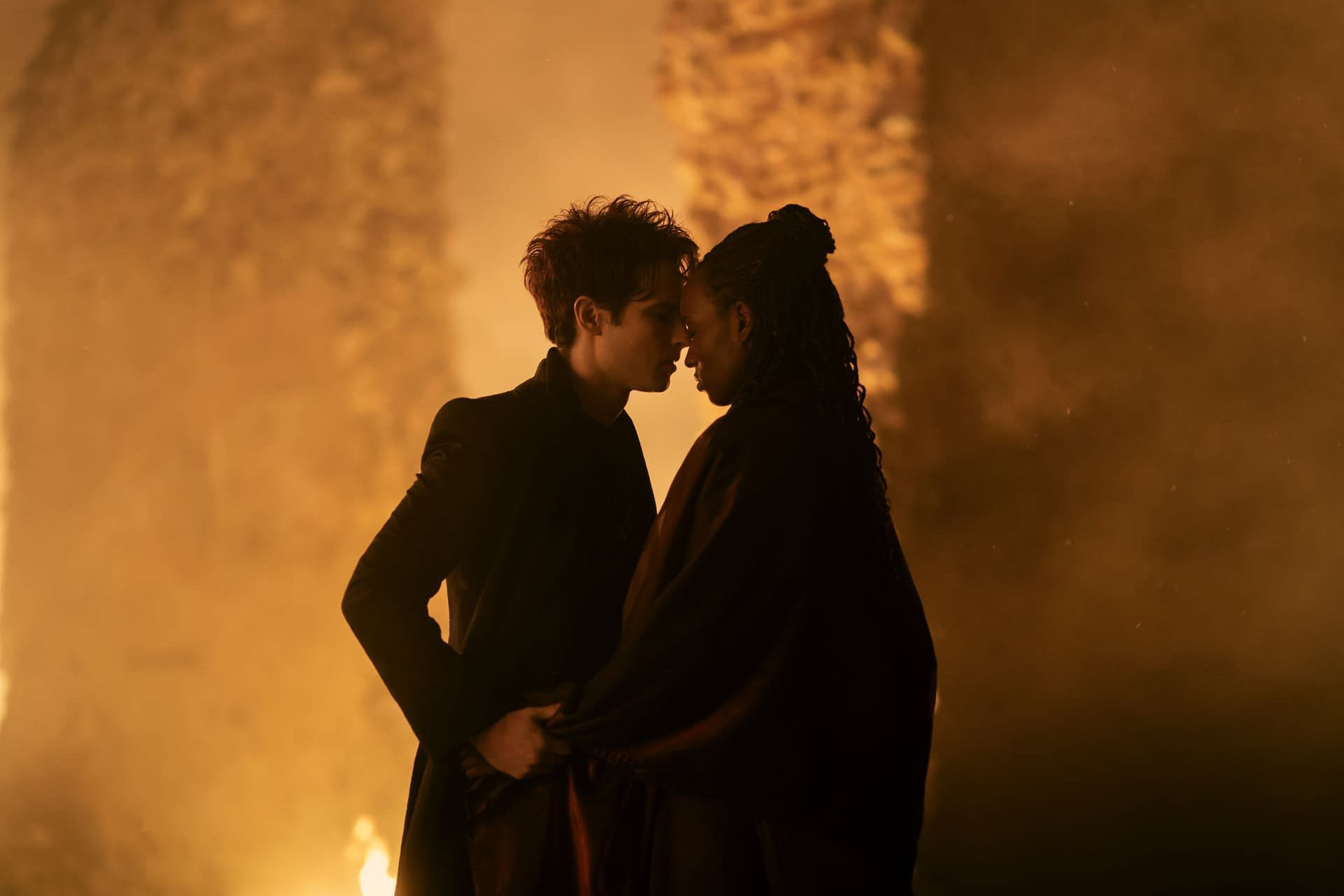
The Netflix series The Sandman presents one of fantasy literature’s most complex love stories. This tale involves Dream of the Endless, a cosmic being who controls all dreams, and Nada, an African queen from 10,000 years ago. Their relationship demonstrates how personal choices by powerful beings can destroy entire civilizations.
This story appears briefly in Season 1 but will receive full treatment in Season 2. Understanding this narrative helps viewers grasp the deeper themes in Neil Gaiman’s work: the relationship between power and responsibility, the consequences of pride, and how cosmic forces affect mortal lives.
Character Background: Who Are Kai’ckul and Nada?
Dream of the Endless as Kai’ckul
Dream of the Endless represents one of seven cosmic entities called the Endless. These beings control fundamental aspects of existence: Dream, Death, Desire, Despair, Destruction, Delirium, and Destiny. Dream controls all sleeping minds and their dreams across the universe.
The name “Kai’ckul” represents how Dream appears to different cultures. His physical form changes based on how each civilization understands their dream deity. To ancient African peoples called the First People, he appeared as Kai’ckul rather than the pale figure modern audiences see.
Nada: The Queen of the First People
Nada ruled an ancient African civilization known as the First People. Historical context suggests this tribe lived in the region where human civilization began. As queen, she possessed both political power and spiritual knowledge, including the ability to communicate with animals and perform magic.
Her character represents wisdom, self-sacrifice, and moral clarity. Unlike many rulers, she consistently placed her people’s welfare above her personal desires, even when facing cosmic powers (Roy, 2022).
The Forbidden Romance: How It Began
The Initial Meeting
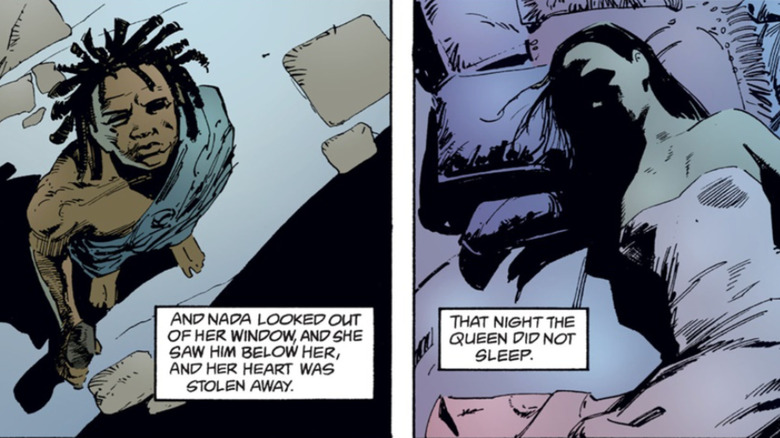
The relationship began when Nada saw a mysterious figure outside her palace. This stranger looked directly at her, creating an immediate emotional connection. However, none of her advisors or guards could identify this person, despite knowing everyone in their territory.
This supernatural element indicated the stranger’s non-human nature. Nada’s curiosity led her to investigate using magical methods available to her culture’s spiritual practices.
The Quest for Truth
Nada enlisted help from local wildlife, particularly birds, to locate the mysterious stranger. A weaverbird eventually brought her a magical berry from trees that only grow in the mountains of the sun. According to legend, consuming this berry would transport someone to their true love’s location.
This quest demonstrates Nada’s determination and resourcefulness. Rather than waiting passively, she actively pursued answers using both political resources and spiritual knowledge (Evangelista, 2022).
Discovery in the Dream Realm
The magical berry transported Nada to the Dreaming, Dream’s realm of existence. There, she learned her beloved’s true identity: Kai’ckul, the Dream Lord, one of the Endless. This revelation created an immediate moral crisis.
Ancient laws prohibited romantic relationships between mortals and the Endless. These rules existed because such relationships inevitably caused disasters for the mortal world. Nada understood these consequences and initially refused Dream’s advances to protect her people.
The Tragic Romance and Its Consequences
The Persuasion
Despite Nada’s initial refusal, Dream pursued the relationship. His persistence eventually overcame her resistance. This dynamic reveals important character traits: Dream’s inability to accept rejection and Nada’s internal conflict between personal desire and moral duty.
The power imbalance between a cosmic entity and a mortal ruler creates ethical problems. Dream’s supernatural nature gave him advantages in persuasion that Nada could not match, raising questions about consent in relationships with extreme power differences.
The Catastrophic Punishment
When the lovers consummated their relationship on a hill overlooking Nada’s city, cosmic forces responded immediately. The Sun, acting as an agent of universal law, sent a fireball that completely destroyed Nada’s glass city and killed all her people (Lealos, 2022).
This destruction demonstrates how cosmic laws operate in Gaiman’s universe. The punishment targeted not just the rule-breakers but their entire civilization, showing how individual choices by powerful beings affect innocent populations.
Nada’s Sacrifice
Witnessing her people’s destruction, Nada committed suicide by throwing herself from the cliff. This action represented both grief and moral responsibility. She recognized that continuing to live might enable further disasters if Dream continued pursuing her.
However, death did not end Dream’s obsession. He followed her spirit to Death’s realm, demonstrating how cosmic beings can transcend normal boundaries that protect mortals from unwanted attention.
Dream’s Ultimate Cruelty: The Condemnation
The Three Chances
In Death’s realm, Dream offered Nada three opportunities to become his queen. Each refusal would increase potential punishment, with the third refusal resulting in eternal torment. This ultimatum reveals Dream’s fundamental character flaw: his inability to accept that others might legitimately reject him.
The structure of three chances appears throughout mythology and fairy tales, often representing fair opportunities for redemption. However, in this context, it becomes a form of psychological torture, as Nada faces impossible choices between personal desires and moral principles.
The Condemnation to Hell
When Nada refused for the third time, Dream condemned her to Hell for eternity. This punishment reveals the extent of his cruelty when his pride is wounded. Rather than accepting her moral reasoning, he chose revenge against someone who had already sacrificed everything to protect others.
This action represents Dream’s lowest moral point in the series. It demonstrates how cosmic beings can become tyrannical when their emotions override their responsibilities (Augustyn, 2022).
The Meeting in Hell: 10,000 Years Later
The Encounter
In Season 1, Episode 4, Dream encounters Nada during his journey through Hell to retrieve his helmet. After 10,000 years of torment, she immediately recognizes him and calls him by his ancient name, Kai’ckul. Her reaction shows both hope for freedom and lingering love despite her suffering.
Dream’s response reveals his unchanged attitude. Despite acknowledging that he still loves her, he states that he has not yet forgiven her. This response shows his continued inability to accept responsibility for the relationship’s tragic consequences.
Psychological Analysis
This brief encounter demonstrates several psychological concepts. Dream exhibits traits consistent with narcissistic personality patterns: inability to accept rejection, lack of empathy for others’ perspectives, and maintaining victimhood narratives even when he caused the harm.
Nada’s response shows remarkable psychological resilience. Despite millennia of torture, she maintains hope and does not express hatred toward her tormentor. This resilience reflects her fundamental character strength and moral clarity.
The Hidden Manipulation: Desire’s Role
The Revelation
Season 1’s conclusion reveals that Desire, Dream’s sibling, orchestrated the entire romance. Desire admits that “Nada was a mistake,” indicating their involvement in creating the tragic situation. This revelation recontextualizes the entire story as part of a larger family conflict among the Endless.
Desire’s manipulation explains some puzzling aspects of the romance: why Dream pursued Nada so aggressively despite knowing the consequences, and why the usual cosmic safeguards failed to prevent the relationship’s formation.
Implications for Character Analysis
While Desire’s manipulation provides some explanation for Dream’s behavior, it does not excuse his choices. Dream still chose to pursue Nada despite her initial refusal, and he alone decided to condemn her to Hell. The manipulation may have created the initial attraction, but Dream’s subsequent actions reflect his own character flaws.
This complexity makes the story more sophisticated than simple victim-perpetrator narratives. It demonstrates how multiple factors can contribute to tragic outcomes while maintaining individual accountability for specific choices.
Literary and Mythological Significance
Universal Themes
The Kai’ckul and Nada story explores several universal themes relevant across cultures and time periods:
- Power and Responsibility: How those with great power must consider the consequences of their actions on others
- Pride and Forgiveness: How pride can prevent healing and perpetuate cycles of harm
- Sacrifice and Moral Duty: When personal desires conflict with ethical obligations
- Justice and Mercy: The difference between punishment and rehabilitation
Cultural Context
Setting this story in ancient Africa serves multiple purposes. It demonstrates that Gaiman’s mythology encompasses global rather than purely Western traditions. It also shows how universal themes manifest differently across cultures while maintaining core emotional truths.
The story’s structure follows patterns from various mythological traditions: the quest narrative, the forbidden love motif, and the tragic consequences of divine-mortal relationships found in Greek, Norse, and other mythologies.
Implications for Season 2
Expected Developments
Season 2 will adapt the “Tales in the Sand” comic story, showing the complete romance in detail. This expansion will provide crucial context for understanding Dream’s character development throughout the series. Showrunner Allan Heinberg has indicated that this story will integrate with the “Season of Mists” storyline, where Dream attempts to rectify his past mistakes (Simons, 2022).
Character Growth Opportunities
The resolution of Nada’s story represents a crucial test for Dream’s character development. His ability to acknowledge wrongdoing, offer genuine apology, and accept Nada’s autonomy will demonstrate whether he has learned from his experiences.
According to comic book sources, this storyline eventually leads to Dream’s recognition of his errors and attempts at redemption. This character growth forms a central arc throughout the series, showing how even cosmic beings can learn empathy and moral responsibility.
Why This Story Endures
The tale of Kai’ckul and Nada resonates because it addresses fundamental questions about power, love, and responsibility. It shows how personal relationships can have cosmic consequences, and how pride can perpetuate cycles of harm across millennia.
More importantly, it demonstrates that redemption requires genuine acknowledgment of wrongdoing and respect for others’ autonomy. Dream’s journey from cosmic tyrant to someone capable of growth and empathy provides hope that even those who have caused great harm can learn to do better.
For viewers of The Sandman, understanding this backstory enriches appreciation of Dream’s character complexity and the series’ exploration of moral growth. It shows how fantasy literature can address serious ethical questions while telling compelling stories about supernatural beings and their very human emotions.
As Season 2 unfolds, this ancient tragedy will finally receive the detailed treatment it deserves, allowing audiences to fully understand one of the most important relationships in Dream’s long existence and its impact on his development as a character capable of both great cruelty and eventual redemption.
Key Takeaways
- The Kai’ckul and Nada storyline demonstrates how cosmic beings’ personal relationships can cause catastrophic consequences for entire civilizations.
- Dream’s condemnation of Nada reveals complex ethical problems regarding power imbalances and consent in supernatural relationships.
- Literary experts recognize this narrative as essential for understanding Dream’s character development and themes of redemption.
Related Articles
- Complete Guide to The Sandman’s Endless Family Powers and Relationships – Learn about all seven cosmic siblings and their complex family dynamics in Neil Gaiman’s universe.
- How The Sandman Adapts Global Mythology for Modern Fantasy Television – Discover how Netflix’s series incorporates mythological traditions from cultures worldwide into contemporary storytelling.
- Dream’s Moral Journey: Character Growth Across The Sandman Series – Analyze how Dream of the Endless evolves from cosmic tyrant to empathetic being throughout the narrative.
