
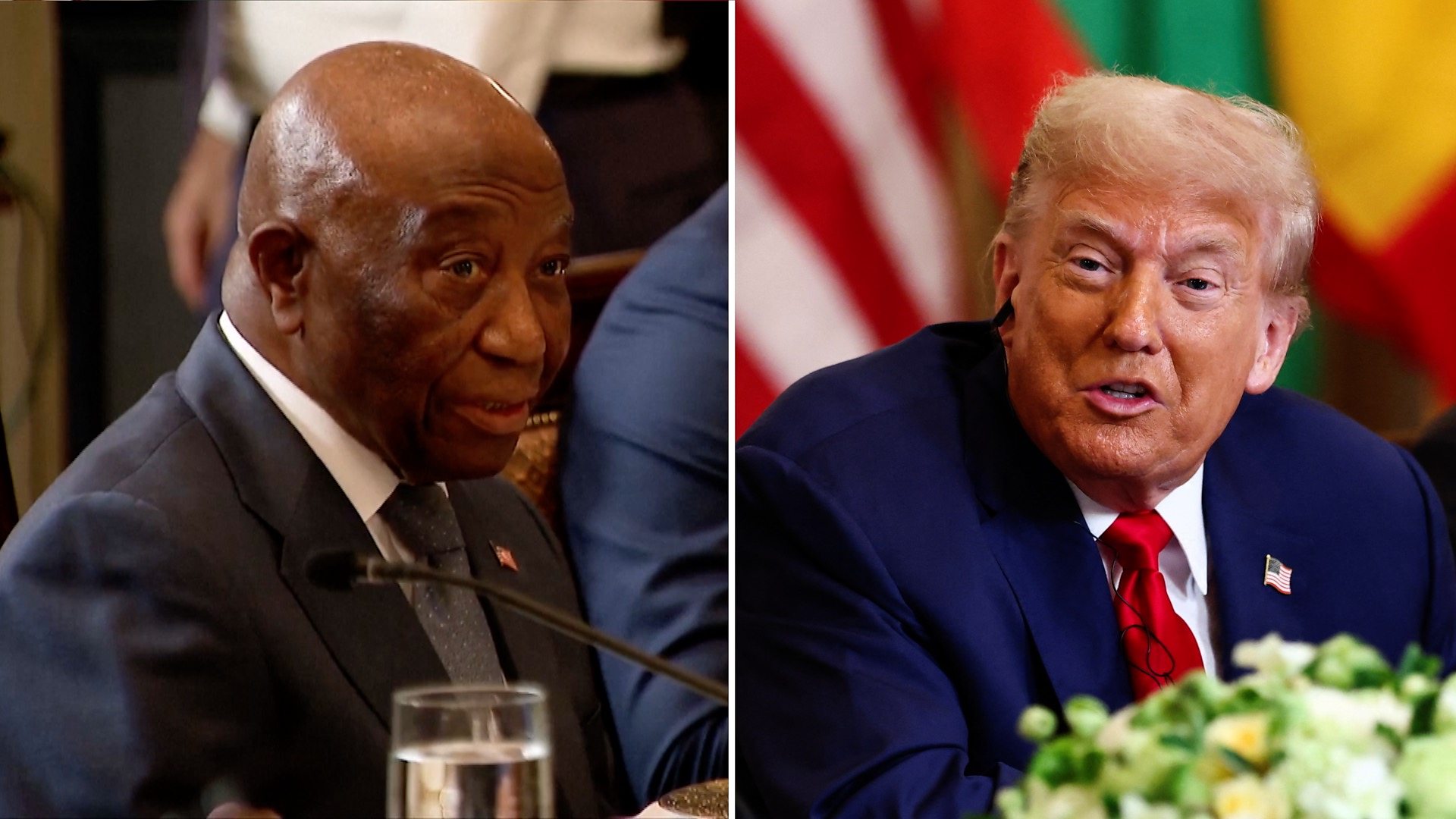
Washington, DC — During a meeting with the leaders of several African nations at the White House, President Donald Trump took a pause Wednesday to compliment Liberian President Joseph Boakai’s command of English. The exchange quickly went viral as observers pointed out that English is Liberia’s official language and the country was founded by freed American slaves.
“Well, thank you,” Trump said after Boakai spoke. “And such good English, that’s beautiful. Where did you learn to speak so beautifully? Where were you educated? Where? In Liberia? Well, that’s very interesting. It’s beautiful English. I have people at this table can’t speak nearly as well”.

Liberia’s American Origins
Trump’s surprise at hearing English spoken in Liberia reveals a lack of awareness about the country’s unique American connection. Liberia is a nation founded by African Americans, both formerly enslaved and freeborn, who moved to Africa beginning in 1822 under the auspices of the American Colonization Society.
Liberia was founded in 1822 as a colony for free Black Americans, the brainchild of white Americans trying to address what they saw as a problem – the future for Black people in the United States. The country declared independence from the American Colonization Society in 1847, making it one of Africa’s oldest republics.
The capital city, Monrovia, is named after U.S. President James Monroe, and the country’s flag closely resembles the American flag with 11 stripes and a single star. This historical connection explains why English became and remains the official language of Liberia, spoken by virtually the entire population.
Mixed Reactions to Trump’s Comments
The response to Trump’s remarks has been divided between those who saw it as an innocent compliment and others who found it condescending. “I felt insulted because our country is an English-speaking country,” Archie Tamel Harris, a Liberian youth advocate, told CNN. “For him to ask that question, I don’t see it as a compliment. I feel that the US president and people in the west still see Africans as people in villages who are not educated”.
A Liberian diplomat who asked not to be named told CNN that they felt the comment “was not appropriate” and “was a bit condescending to an African president who’s from an English-speaking nation”. Social media users were quick to mock the exchange, with some calling it “peak ignorance.”
However, Liberia’s government offered a more diplomatic interpretation. “What President Trump heard distinctly was the American influence on our English in Liberia, and the Liberian president is not offended by that,” Liberia’s Foreign Minister Sara Beysolow Nyanti told CNN.
President Boakai’s Background
Joseph Boakai, who politely laughed at Trump’s comments, has an extensive background in both business and government. Boakai, who has held a number of executive roles in private business and government, was born in a remote village but was determined to secure an education, which he ultimately did in Monrovia, the country’s capital.
Boakai previously served as Liberia’s Vice President under Ellen Johnson Sirleaf from 2006 to 2018 before winning the presidency in 2023. His education and career were entirely conducted in English, as it would be for virtually any Liberian leader, given the country’s linguistic heritage.
The White House Defense
Reached for comment, White House spokesperson Anna Kelly called Trump’s remarks “a heartfelt compliment during a meeting that marked a historic moment for U.S.-Africa relations”. The administration framed the incident as media overreach rather than acknowledging any diplomatic misstep.
In response to criticism of Trump’s comments to Boakai, a White House spokeswoman told the New York Times in a statement that, “only the fake news could so pathetically pick apart President Trump’s heartfelt compliment during a meeting that marked a historic moment for U.S.-Africa relations”.
Pattern of Condescending Comments
This wasn’t the first time Trump has made comments about foreign leaders’ English abilities. Trump has previously applauded the English language abilities of other leaders during diplomatic meetings. During a press conference with German Chancellor Friedrich Merz, Trump complimented his “good English” and asked if it was as good as his German.
However, the Liberia incident stands out because English is not just widely spoken there but is literally the country’s founding language, brought by American settlers nearly 200 years ago. The historical irony makes Trump’s surprise particularly notable.
Why This Meeting Mattered
Trump invited the leaders of Gabon, Senegal, Mauritania, and Guinea-Bissau, as well as other African nations rich in natural resources, to the Wednesday White House meeting after signing an executive order in March to increase American mineral production.
Liberia’s real GDP is expected to grow around 5 percent in 2025, driven by continued expansion in mining, especially gold, and improvements in agriculture and services, according to the World Bank. The meeting focused on securing access to critical minerals and strengthening economic partnerships with African nations.
Broader Implications
The incident highlights ongoing challenges in U.S.-Africa diplomatic relations, where cultural misunderstandings and colonial-era assumptions can undermine serious policy discussions. As sociophonetician Nicole Holliday told the Washington Post in 2016, “You can go anywhere in the world and ask who speaks the ‘bad’ version of the language — and invariably, it’s the people who are marginalized, who are rural, poor, or belong to religious minorities”.
For Liberia specifically, the exchange touched on sensitive historical themes about American perceptions of Africa and African capabilities. Despite the country’s unique American heritage and English-speaking status, Trump’s reaction suggested unfamiliarity with basic facts about a nation that has been a U.S. ally for over a century.
The incident serves as a reminder that successful diplomacy requires cultural awareness and historical knowledge, particularly when engaging with nations that have complex relationships with American history and identity.
