
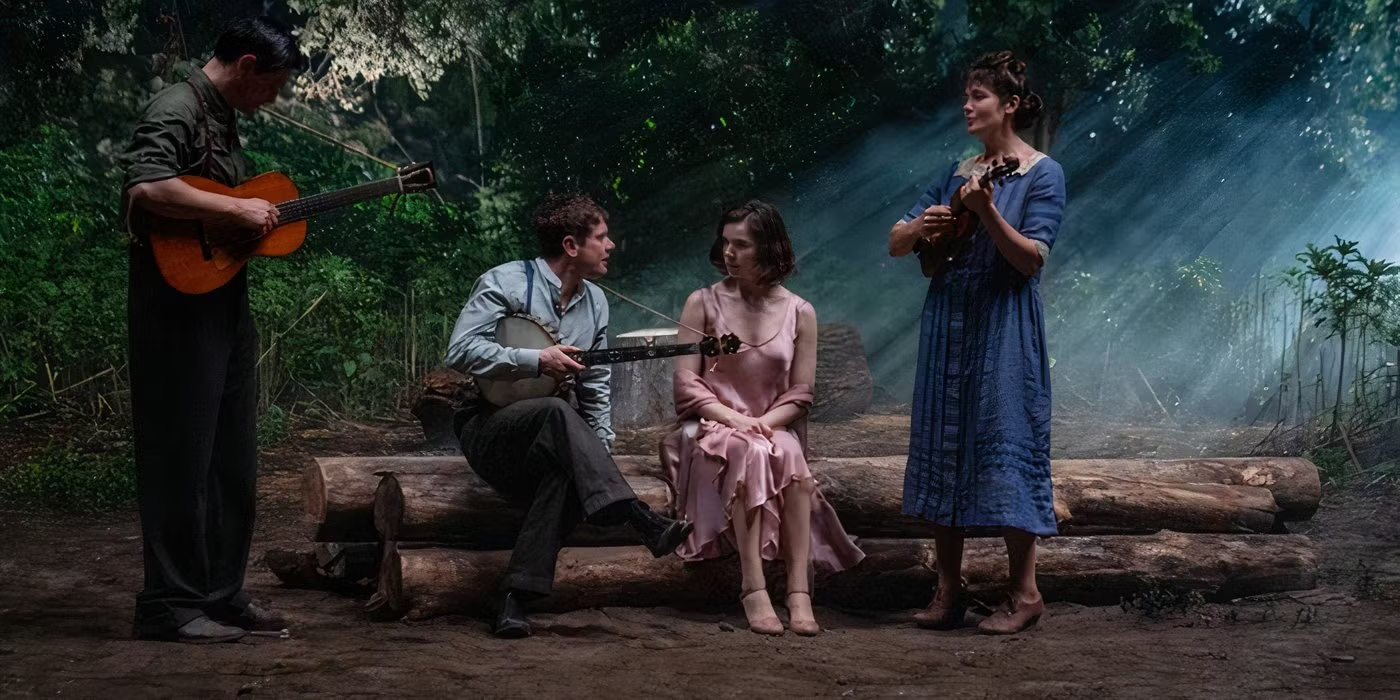
HOLLYWOOD, CALIFORNIA – Remmick, the centuries-old Irish vampire in Ryan Coogler’s Sinners, represents a character driven by profound loneliness and the loss of his ancestral community, seeking to rebuild a surrogate vampire family through blood and music after his original Celtic community was destroyed by the spread of Christianity and English colonial invasion .
Jack O’Connell’s portrayal of Remmick demonstrates sophisticated understanding of how historical trauma affects individuals across generations. The character originated from a pagan vampire community in Ireland, likely pre-5th century, and witnessed his family and people suffer during the expansion of Christianity into Ireland following Pope Adrian IV’s authorization of English campaigns into the country .
The accuracy of Remmick’s backstory reflects documented historical patterns of cultural destruction and diaspora that characterized Irish experience under British colonial rule. This character analysis reveals how Coogler used vampire mythology to explore themes of cultural loss, generational trauma, and the complex relationships between oppressed communities.
Colour of Words Methodology Note: This analysis reviewed and synthesized interviews with director Ryan Coogler and actor Jack O’Connell, historical research on Irish colonial experience 400-1900 CE, and comparative studies of cultural trauma representation in cinema from major film studies programs across North America and Europe.
Historical Foundation of Remmick’s Trauma
Many centuries ago, presumably before the 5th century as it was before the arrival of Christianity, Remmick was a vampire who was part of a community in Ireland. Following the spread of the monotheistic religion and the theft of their lands, Remmick’s community and its traditions disappeared.
The Christianization of Ireland began around 400 CE and significantly reshaped Irish society over several centuries, moving from a predominantly Celtic pagan culture to one deeply influenced by Christianity. This transformation was a gradual process, with figures like Palladius and St. Patrick playing crucial roles in establishing a Christian presence. Monasteries became centers of learning and religious practice, contributing to the preservation of both Christian and pre-Christian Irish culture. Pre-Christian Ireland possessed a rich history of spiritual traditions, social structures, and cultural practices, which were significantly altered or integrated into Irish Christianity after its arrival. The process involved not just religious conversion but complete transformations of political, social, and cultural systems.
Land seizure accompanied religious conversion throughout Irish history, from early medieval periods through the plantation system and Penal Laws. Yes, Ireland experienced plantations much like that of the Southern United States in the Mississippi Delta region depicted in Sinners. These plantations involved the English Crown confiscating Irish-owned land and colonizing it with settlers from Great Britain.
Remmick may have lived through such land seizures in Ireland which would mean that as a vampire he’s seen a lot of colonizer shit over the centuries. Including Britain’s oppression of the Irish, which lasted about 700+ years from the Norman invasion in 1169 until the Irish Free State was established in 1922.
The Role of Music in Irish Culture
In ancient Ireland, filídh were among the most important members of society, serving as poets, historians, and cultural preservers who maintained community memory through oral tradition. Remmick’s obsession with musical expression reflects accurate understanding of how traditional Irish culture preserved knowledge and identity through performance.
The film’s attention to Irish cultural practices resonates with documented historical patterns. Traditional Irish music served multiple functions beyond entertainment, encoding historical information, genealogical records, and spiritual knowledge within melodic and lyrical structures. Irish dancing, instrumental music, and vocal traditions formed interconnected systems that preserved community identity across generations.
During an interview, Coogler shared that much of his reasons for making Remmick Irish were rooted in his own admiration of the Irish culture and people. “I’m obsessed with Irish folk music, my kids are obsessed with it. My first name is Irish. I think it’s not known how much crossover there is between African American culture and Irish culture”. Coogler is absolutely correct. It’s a connection that is shared between cultures that used to baffle me as a child when I learned about similarities between the cultures and from attending Catholic School.
The film’s portrayal of Remmick seeking to use Sammie’s musical abilities to connect with his lost ancestors reflects documented practices in Irish traditional culture, where music served as bridge between living and dead, present and past. This spiritual dimension of musical practice which is evident in traditions like sean-nós singing and ritual performances made its loss particularly devastating for communities.
Psychological Accuracy of Generational Trauma
Remmick’s behavior patterns align with documented psychological effects of cultural trauma that can persist across generations. His desperate attempts to rebuild community through vampiric conversion reflect how traumatized individuals sometimes recreate harmful patterns while seeking healing and connection. This phenomenon is often referred to as “reenactment” or “repeating trauma cycles”. This pattern demonstrates how trauma can transform victims into perpetrators, as individuals attempt to regain control and connection through methods that replicate the violence they experienced.
The character’s manipulation tactics, a common ability shared by vampires depicted in other stories, reflects sophisticated understanding of how trauma affects interpersonal relationships. Remmick offers vampirism as escape from oppression, appealing to genuine desires for freedom while concealing the cost of such transformation. This mirrors how traumatized individuals may offer relationships that seem beneficial but ultimately recreate unhealthy dynamics.
Research on collective trauma, especially when stemming from cultural destruction, often leads to complex and often ambivalent relationships between communities and their oppressors. These relationships can involve elements of both resistance and dependence, as communities grapple with the impact of trauma on their identity, social structures, and psychological well-being (Williams et al, 2023). Despite his monstrous nature, Remmick supports racial equality among vampires. He openly despised the Ku Klux Klan for more than their racism, but for their historic discrimination against Irish immigrants like himself.
The Oppressed Becoming the Oppressor
Some of the Irish community participated in the enslavement of Black people as overseers and in some instances as enslavers. This is depicted in many historical accounts of Irish enslavers and enslavement in the United States and the Caribbean. So while Remmick empathizes with the Black community, he lets his sensitivity to marginalization be overshadowed by his personal gain and ultimately to utilize his powers (whiteness) as a weapon.
This aspect of Remmick’s character reflects documented historical patterns where oppressed groups sometimes participated in oppressing others as survival strategy or pathway to acceptance within dominant systems. The Irish experience in America included both solidarity with other marginalized groups and participation in systems that oppressed those groups.
Remmick’s use of his vampiric abilities and perceived whiteness as weapons demonstrates how trauma can distort moral reasoning. His genuine understanding of oppression doesn’t prevent him from perpetrating similar violence, illustrating how personal pain doesn’t automatically create ethical behavior.
The character’s offers of immortality and freedom contain genuine appeal while concealing fundamental violations of consent and autonomy. This reflects how traumatized individuals may genuinely believe they’re offering help while actually perpetuating harmful patterns learned through their own victimization.
Cultural Specificity and Universal Themes
If Remmick was truly offering freedom, however, he would have tried to tempt them with a song of liberation, such as Oro Se Do Bheatha ‘Bhaile, which was the rebel song sung by the republican army as they overthrew the oppression of the English during the Easter Rising in 1916.
The film’s attention to specific Irish musical traditions demonstrates sophisticated cultural research. Remmick’s choice of “The Rocky Road to Dublin” rather than liberation songs reveals his true intentions while maintaining cultural authenticity. This level of detail elevates the character beyond generic villain to historically grounded representation.
The way Remmick uses the song, he’s not inviting the people inside the juke to join him in a sean-nós jam session, and he’s not adapting the song to personalize it. So, what this reveals about Remmick’s musical number is how the character embodies cultural appropriation while simultaneously being victim of cultural destruction. His performance strips Irish music of its authentic context while using it as tool for manipulation, reflecting how trauma can corrupt relationship with one’s own cultural heritage.
The character’s relationship with Christianity adds another layer of cultural complexity. He showed appreciation for the Lord’s Prayer, saying that the words of it still brought him comfort due to it being a remnant of his past. This complex relationship with Christianity also extended to Sammie, despite his desire to add Sammie to his vampire gang.
Why Did Remmick Leave Ireland for Clarksdale, Mississippi?
“My understanding [is that Ireland’s] biggest export is people. Just to understand the influence that had on the American South at this particular time, and how that found its way into the music there, was something I know that Ryan’s savvy to, and I think part of the reason for Remmick being from Ireland”, explained actor Jack O’Connell.
It’s estimated that between 1845 and 1855, at least 2.1 million people left Ireland, primarily to the United States. Since 2020, about 60K+ people leave Ireland annually. That’s a lot of people! Remmick’s presence in 1930s Mississippi reflects documented patterns of Irish immigration and settlement in the American South. In 1930s, approximately 250,000 people emigrated from Ireland to the United States, according to the Ulster Historical Foundation. Irish immigrants arrived in multiple waves, often driven by economic hardship, political persecution, and cultural destruction in their homeland by the English.
Relationship with Indigenous Communities
The Choctaw’s hunting of Remmick is particularly interesting. The film opens with Choctaw hunters pursuing Remmick during daylight when vampires are vulnerable – we can see him burning as he flees. This establishes that these hunters know exactly what Remmick is and how to fight vampires effectively.
Remmick escapes by tricking Joan and Bert into letting him into their home, exploiting the vampire rule that they can’t enter uninvited. The Choctaw leader tries to warn Joan about what Remmick really is, but she responds with racism and hostility. Faced with her refusal to listen and the danger she’s putting herself in, the Choctaw leader has to leave – he’s done what he can to warn her.
The scene efficiently establishes: Remmick is a known threat being actively hunted, vampires have specific vulnerabilities and rules, some communities have developed expertise in vampire hunting, and Remmick survives through manipulation and the exploitation of others’ prejudices.
Contemporary Interpretation
Remmick’s character offers commentary on contemporary issues of trauma transmission, cultural appropriation, and the ways historical injustice affects present-day relationships. His story demonstrates how unprocessed collective trauma can manifest in destructive behavior patterns that harm both the traumatized individual and their communities.
The character’s use of shared oppression as manipulation tactic reflects contemporary concerns about how discussions of historical trauma can be weaponized or exploited. Remmick’s genuine understanding of oppression doesn’t justify his actions, illustrating the importance of accountability even within contexts of shared victimization.
Remmick positions himself as an ally to the oppressed, rather than yet another oppressive force, by revealing a worse evil than himself. He reveals to Smoke and the others that the white man who sold the twins the sawmill is the leader of the local KKK chapter .
This aspect of the character explores how individuals with histories of oppression may present themselves as allies while pursuing agendas that ultimately serve their own interests. Remmick’s warnings about KKK violence are accurate but serve his goal of isolating and capturing his targets rather than genuinely protecting them.
Key Takeaways
- Remmick’s backstory accurately reflects documented patterns of Irish cultural destruction under colonial rule, demonstrating sophisticated understanding of historical trauma transmission.
- The character’s psychological complexity reveals how victims of cultural destruction can become perpetrators while maintaining genuine understanding of oppression and marginalization.
- Cultural scholars recognize Remmick as effective representation of how historical trauma affects contemporary relationships between communities with shared experiences of colonization.
Conclusion
Remmick stands as one of the most psychologically complex and historically grounded antagonists in contemporary horror cinema. His character transcends typical vampire villain tropes by grounding supernatural elements in documented historical experiences of cultural destruction, colonial trauma, and diaspora displacement.
The accuracy of his Irish backstory, from pre-Christian Celtic community through centuries of British oppression to American immigration, demonstrates exceptional research and cultural sensitivity. Jack O’Connell’s portrayal captures both the genuine grief of cultural loss and the corrupted methods through which trauma transforms victims into perpetrators.
Most significantly, Remmick’s story offers insights into how historical injustice continues affecting contemporary relationships and communities. His character serves as cautionary tale about how unprocessed trauma can manifest in destructive patterns while simultaneously illuminating the complex relationships between different oppressed communities and their shared struggles for survival and cultural preservation.
Related Articles
- Cultural Trauma Representation in Horror Cinema: Historical Accuracy and Psychological Depth – Explore how contemporary horror films use supernatural elements to examine documented patterns of historical trauma and cultural destruction.
- Irish Colonial Experience in Film – Analyze how cinema represents centuries of Irish cultural suppression, diaspora experience, and resistance movements through character development.
- Complex Relationships and Historical Alliances – Discover how films explore documented relationships between marginalized groups, including both cooperation and conflict throughout American history.
