
Understanding the Endless
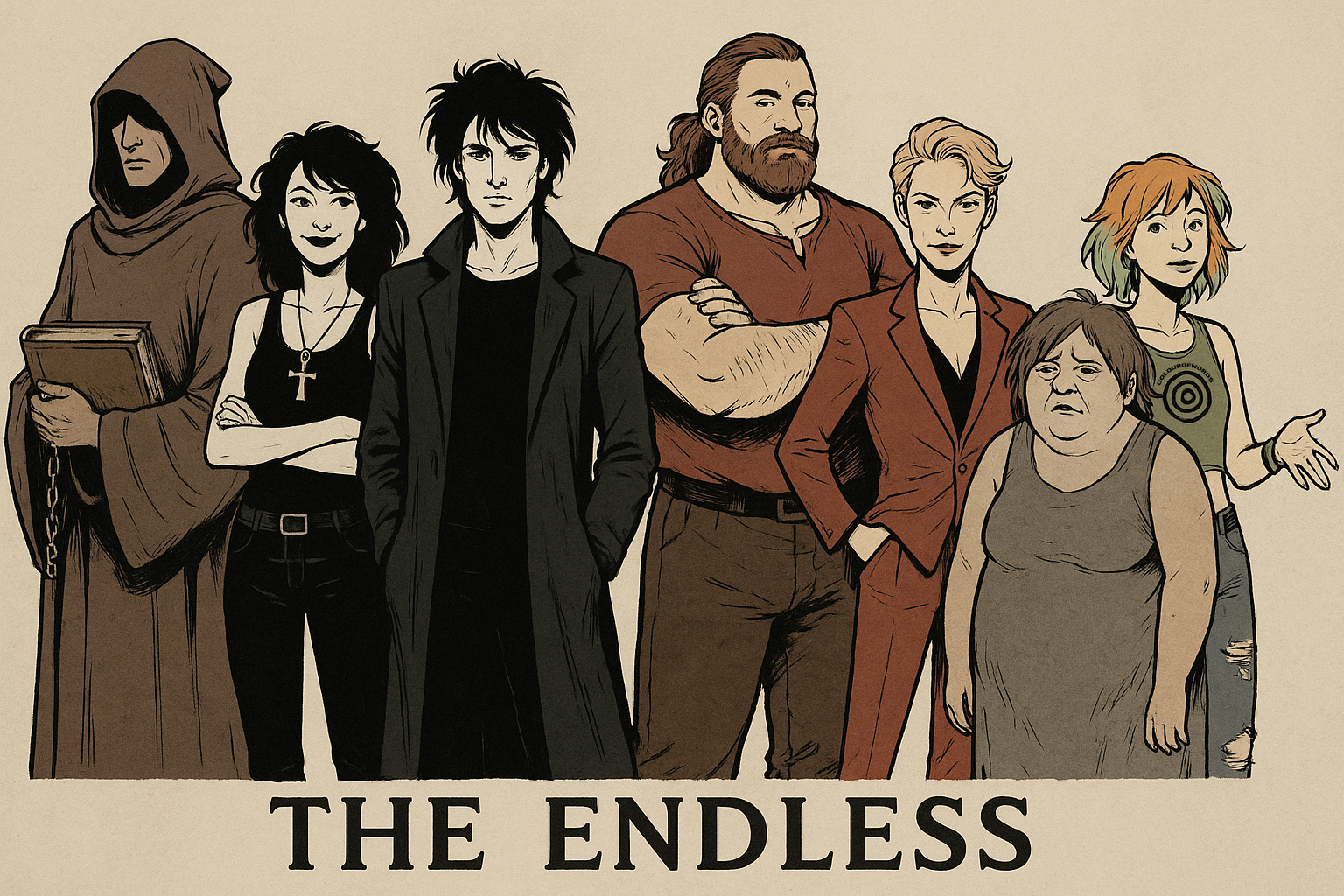
The Endless represent the most powerful beings in Neil Gaiman’s The Sandman universe. These seven cosmic siblings personify fundamental aspects of existence that affect every living creature. Unlike gods, who depend on worship and belief, the Endless exist as long as life itself continues. They are older than gods, more powerful than demons, and essential to the fabric of reality.
Each member of the Endless family controls a specific domain of existence: dreams, death, desire, despair, destruction, delirium, and destiny. Their relationships with each other create the underlying tensions that drive many of the series’ most important storylines. Understanding their powers and family dynamics provides crucial insight into The Sandman’s mythology and themes.
This guide examines each family member’s abilities, responsibilities, and relationships. We will explore how their interactions shape events across the series and why their family meetings often determine the fate of entire universes.
The Nature of the Endless
What Makes Them Different
The Endless differ from other supernatural beings in several important ways. First, they represent abstract concepts rather than physical forces. While gods might control lightning or war, the Endless embody experiences that define conscious existence itself.
Second, they cannot truly die in conventional terms. When an Endless appears to perish, they transform rather than disappear entirely. Their function continues under a new personality, maintaining cosmic balance while allowing for character development and change.
Third, their power operates automatically rather than requiring conscious effort. Death does not need to actively kill people; mortality exists as a natural consequence of her presence in the universe. Similarly, Dream does not create each individual dream but provides the framework within which all dreaming occurs.
The Gallery of the Endless
The Endless family maintains a cosmic meeting place called the Gallery of the Endless. This space exists outside normal reality, allowing the siblings to gather when universe-threatening situations require their collective attention. The Gallery contains representations of each family member’s domain, creating a neutral space where their different natures can coexist.
Family meetings in the Gallery follow specific protocols developed over billions of years. These gatherings occur rarely, typically only when one sibling’s actions threaten cosmic stability or when external forces challenge the Endless’s authority over their domains.
Dream of the Endless (Morpheus)
Powers and Domain
Dream controls all aspects of sleeping consciousness across the universe. His domain, called the Dreaming, contains every dream, nightmare, and fantasy ever experienced by any conscious being. This realm exists parallel to physical reality but operates according to different laws based on imagination rather than physics.
Within the Dreaming, Dream possesses absolute authority. He can reshape reality at will, create sentient beings from pure thought, and access the memories and desires of any dreaming mind. His power extends beyond sleep to include all forms of inspiration, creativity, and storytelling. Artists, writers, and inventors often unconsciously draw upon his realm for their ideas.
Dream’s most significant tools include his helm of office, a pouch of dream sand, and a ruby containing concentrated dream essence. These artifacts focus his power but do not create it. Even without them, he remains one of the most formidable beings in existence, capable of restructuring reality through will alone.
Personality and Relationships
Among the Endless, Dream exhibits the most complex and troubled personality. He struggles with pride, stubbornness, and difficulty accepting change. These character flaws create conflicts with his siblings and complicate his relationships with mortals. His romantic history includes several tragic relationships, most notably with the ancient queen Nada, whom he condemned to Hell for refusing his advances.
Dream’s relationship with his siblings reflects his complicated nature. He maintains formal courtesy but often seems distant and superior. His closest relationship appears to be with Death, who serves as both confidante and moral guide. His most antagonistic relationship involves Desire, who frequently manipulates situations to cause Dream embarrassment or pain.
Character Development
Throughout the series, Dream undergoes significant character growth. Initially portrayed as coldly distant and prideful, he gradually learns empathy and responsibility. This development occurs through confronting the consequences of his past actions and accepting guidance from Death and other siblings.
His evolution culminates in recognizing the need for change in his fundamental nature. This realization leads to one of the series’ most dramatic transformations, demonstrating that even cosmic beings can grow beyond their original limitations.
Death of the Endless
Powers and Domain
Death governs the transition from life to whatever comes after. She appears at the moment of every death across the universe, providing comfort and guidance during this fundamental transformation. Her presence ensures that death remains a natural process rather than a traumatic rupture.
Unlike popular depictions of death as frightening or malevolent, Gaiman’s Death appears as a kind, wise young woman who treats her responsibility with compassion and humor. She understands that death gives meaning to life by providing boundaries and consequences for choices.
Death’s powers include the ability to end any existence, regardless of its nature or supposed immortality. She can also grant life in exceptional circumstances, though this violates cosmic order and occurs extremely rarely. Her knowledge encompasses all past and future deaths, giving her unique perspective on the patterns of existence.
Personality and Relationships
Death serves as the emotional center of the Endless family. Her wisdom, compassion, and practical nature make her the sibling others turn to for advice and support. She treats her cosmic responsibilities with appropriate seriousness while maintaining a warm, accessible personality that helps others cope with difficult situations.
Her relationship with Dream provides one of the series’ most important dynamics. Death frequently challenges Dream’s self-pity and pride, pushing him toward greater self-awareness and empathy. She serves as his moral compass while respecting his autonomy and growth process.
Death maintains positive relationships with most of her siblings, though she sometimes grows frustrated with their tendency toward drama and self-absorption. Her practical nature helps resolve family conflicts by focusing attention on consequences rather than pride or past grievances.
Cultural Impact
Death’s portrayal in The Sandman revolutionized how popular culture depicts mortality. By presenting death as kind rather than cruel, wise rather than arbitrary, Gaiman created a character who helps readers confront their own mortality with less fear and greater acceptance.
Her popularity led to several spin-off stories exploring her interactions with mortals. These tales consistently emphasize themes of acceptance, the value of life, and the importance of treating others with kindness during difficult times.
Desire of the Endless
Powers and Domain
Desire embodies all forms of wanting, longing, and craving experienced by conscious beings. Their domain includes romantic love, sexual attraction, ambition, greed, and any other form of yearning that motivates behavior. Desire’s influence operates through creating and manipulating the wants that drive most conscious actions.
Desire possesses the ability to inspire overwhelming longing in any being, regardless of their nature or previous desires. They can also fulfill desires instantly, though such fulfillment often comes with unexpected consequences. Their realm, called the Threshold, exists at the border between dream and reality, allowing access to both conscious and unconscious wants.
Unlike other Endless, Desire frequently intervenes directly in mortal affairs. They enjoy manipulating situations to create dramatic outcomes, particularly when such manipulation might embarrass or harm their siblings, especially Dream.
Personality and Relationships
Desire presents as beautiful, charismatic, and deliberately ambiguous in both gender and motivation. They shift appearance constantly, always appearing as exactly what their current target finds most attractive. This shapeshifting reflects their fundamental nature as the embodiment of wanting itself rather than any specific object of desire.
Their most significant relationship involves their ongoing conflict with Dream. Desire delights in creating situations that force Dream into difficult positions, often by manipulating his romantic relationships or challenging his pride. This antagonism stems partly from sibling rivalry and partly from fundamental philosophical differences about the nature of love and attachment.
Desire maintains a close relationship with their twin, Despair, sharing both living space and emotional connection. Together, they represent the dual nature of wanting: the hope that desire creates and the disappointment that often follows its fulfillment.
Moral Complexity
Desire operates in moral gray areas more than other Endless. While their function serves important purposes in motivating growth and change, their methods often cause suffering and confusion. They represent both the creative force of ambition and the destructive power of obsession.
This complexity makes Desire one of the series’ most challenging characters to evaluate. Their actions frequently harm others, yet they also provide the motivation necessary for most forms of progress and achievement. Understanding Desire requires accepting that some forces in existence are neither entirely good nor entirely evil.
Despair of the Endless
Powers and Domain
Despair governs all forms of hopelessness, depression, and emotional suffering experienced by conscious beings. Her realm contains mirrors that reflect the despair present in every corner of existence, allowing her to observe and sometimes influence the darkest moments in any being’s life.
Her powers include the ability to inspire overwhelming sadness and the loss of hope in any conscious being. However, unlike malevolent entities that create despair for destructive purposes, Despair serves a cosmic function by helping beings process grief, loss, and disappointment as natural parts of existence.
Despair’s domain also encompasses the necessary role that suffering plays in growth and understanding. Without the capacity for despair, beings cannot fully appreciate joy, hope, or achievement. Her function provides emotional depth and resilience by forcing consciousness to confront difficult realities.
Personality and Relationships
Despair appears as a heavy-set, pale woman who speaks softly and moves slowly. She carries herself with the weight of all the sadness she has witnessed, yet maintains dignity and purpose in her cosmic role. Unlike stereotypical depictions of depression as purely destructive, Despair understands her function’s importance in the larger pattern of existence.
Her closest relationship is with her twin Desire, with whom she shares living space and deep emotional connection. This pairing reflects the intimate relationship between wanting and disappointment, hope and sadness. Together, they represent the complete cycle of emotional experience that defines conscious existence.
Despair maintains respectful but distant relationships with her other siblings. She rarely participates in family conflicts, preferring to observe and offer quiet wisdom when asked. Her perspective on existence emphasizes acceptance and endurance rather than dramatic action or change.
Philosophical Significance
Despair’s role in the series explores important questions about the meaning and value of suffering. Rather than presenting despair as purely negative, Gaiman uses this character to examine how difficult experiences contribute to wisdom, compassion, and personal growth.
Her presence in the Endless family suggests that emotional pain serves necessary functions in cosmic order. This perspective challenges simplistic views that seek to eliminate all forms of suffering without considering their potential value in creating depth and resilience.
Destruction of the Endless
Powers and Domain
Destruction governs all forms of ending, dissolution, and transformation through force. His domain includes natural disasters, wars, aging, decay, and any process that breaks down existing structures to make way for new ones. However, destruction in this context serves creative rather than purely negative purposes.
Destruction’s power operates on multiple levels simultaneously. He influences physical processes like erosion and entropy, social changes like revolutions and cultural shifts, and personal transformations like growth through adversity. His function recognizes that creation requires the elimination of previous forms and structures.
Unlike other Endless, Destruction abandoned his post several centuries ago, choosing to explore existence as a more conventional being rather than fulfilling his cosmic responsibilities. This abandonment allows destruction to continue operating automatically while freeing him from the constraints of his official role.
Personality and Relationships
Before abandoning his post, Destruction appeared as a large, jovial man who approached his responsibilities with surprising optimism and creativity. He understood that his function, while often painful, served essential purposes in maintaining cosmic balance and enabling growth.
His decision to leave his post reflects a desire for personal freedom and direct experience rather than abstract cosmic responsibility. This choice demonstrates that even beings with universal responsibilities can choose different paths when their functions no longer require direct oversight.
Destruction maintains affectionate relationships with his siblings, though his absence creates practical and emotional complications for family dynamics. His departure forces other family members to compensate for his absence while dealing with their own reactions to his unprecedented choice.
Thematic Importance
Destruction’s abandonment of his post explores themes of personal autonomy versus cosmic responsibility. His story suggests that individuals, even those with universal obligations, have the right to choose their own paths when circumstances permit.
His continued function despite his absence also demonstrates the difference between personal involvement and cosmic necessity. Some forces operate independently of conscious oversight, allowing for both universal order and individual freedom.
Delirium of the Endless (Formerly Delight)
Powers and Domain
Delirium governs all forms of madness, confusion, and altered consciousness. Her domain includes mental illness, drug-induced states, religious ecstasy, creative inspiration, and any condition where normal rational thought gives way to different forms of awareness.
Originally known as Delight, she transformed into Delirium after experiencing some cosmic trauma that fundamentally altered her nature. This change reflects how even the Endless can evolve in response to overwhelming experiences, though such transformations occur rarely and with significant consequences.
Delirium’s powers include the ability to induce various forms of madness, grant prophetic visions, and access forms of knowledge unavailable to rational thought. Her insights often prove more accurate than logical analysis, suggesting that madness sometimes provides access to deeper truths about existence.
Personality and Relationships
Delirium appears as a young woman whose appearance and behavior constantly shift between childlike innocence and disturbing unpredictability. She speaks in scattered, seemingly random statements that often contain profound insights delivered in unexpected ways.
Her transformation from Delight to Delirium affects her relationships with family members, who remember her previous nature while adapting to her current condition. Dream shows particular protectiveness toward her, possibly because he understands the pain of fundamental change.
Despite her chaotic nature, Delirium maintains deep emotional connections with her siblings. Her seemingly random comments often address their unspoken concerns or hidden fears, suggesting that her altered consciousness provides unique insight into family dynamics.
Symbolic Meaning
Delirium’s character explores the relationship between madness and wisdom, chaos and creativity. Her transformation from Delight to Delirium suggests that intense joy and intense suffering can both lead to altered states of consciousness that transcend normal limitations.
Her presence in the family represents the possibility of radical change and the value of different forms of consciousness. Through Delirium, the series examines how mental states typically labeled as illness might sometimes provide access to important truths unavailable through conventional thought.
Destiny of the Endless
Powers and Domain
Destiny represents the oldest and most powerful of the Endless, governing fate, causality, and the predetermined aspects of existence. He carries a book that contains everything that has happened, is happening, and will happen throughout all of reality. His domain encompasses the fixed patterns that underlying cosmic order.
Destiny’s power operates through knowledge rather than direct intervention. He understands the consequences of all actions and the ultimate outcomes of all choices, but he rarely acts to change events. His role involves witnessing and recording rather than controlling or preventing.
Unlike his siblings, Destiny appears blind and chained to his book, symbolizing both the burden and limitation of perfect knowledge. He sees all possible futures but cannot choose which ones will occur, representing the tension between free will and predetermined fate.
Personality and Relationships
Destiny presents as remote, formal, and often cryptic in his communications with family members. His vast knowledge creates emotional distance from immediate concerns, though he clearly cares about his siblings’ welfare and the cosmic order they collectively maintain.
His relationships with other family members reflect his unique position as both eldest sibling and cosmic observer. Other Endless respect his authority while sometimes growing frustrated with his tendency to speak in riddles or withhold crucial information.
Destiny rarely participates directly in family conflicts, preferring to offer guidance through carefully chosen words or by revealing relevant information from his book. His interventions, when they occur, typically prove decisive because of his unique perspective on cause and effect.
Philosophical Role
Destiny’s character explores fundamental questions about determinism, free will, and the nature of choice. His knowledge of all possible outcomes raises questions about whether the future is fixed or whether knowledge of possibilities can influence which ones become reality.
Through Destiny, the series examines the relationship between fate and responsibility. If outcomes are predetermined, do choices matter? If they are not, how can perfect knowledge exist? These questions remain unresolved, reflecting real philosophical debates about causality and consciousness.
Family Dynamics and Relationships
Sibling Hierarchies
The Endless family operates according to complex hierarchies based on age, power, and function. Destiny, as the eldest, commands general respect, though his siblings do not automatically defer to his judgment on all matters. Death, despite being younger than Destiny, often serves as emotional leader due to her wisdom and compassion.
Dream occupies a middle position in family dynamics, old enough to command respect but young enough to make significant mistakes. His relationships with both older and younger siblings reflect different aspects of his character development throughout the series.
The younger Endless—Desire, Despair, Destruction, and Delirium—form their own subgroup within the family, though their relationships vary significantly in closeness and conflict level. Desire and Despair’s twin bond creates the family’s most intimate relationship, while Destruction’s absence affects everyone differently.
Sources of Conflict
Family conflicts among the Endless typically arise from fundamental differences in philosophy and approach rather than simple personality clashes. Dream’s pride and rigidity conflict with Desire’s love of chaos and manipulation. Death’s practical wisdom sometimes clashes with Destiny’s abstract perspective on cosmic order.
The most significant ongoing conflict involves Dream and Desire’s mutual antagonism. This relationship drives many of the series’ major plot developments, as Desire’s manipulations frequently force Dream into difficult situations that challenge his growth and understanding.
Destruction’s abandonment of his post creates another source of family tension. Some siblings support his choice to pursue personal freedom, while others worry about the cosmic implications of an Endless refusing their responsibilities.
Moments of Unity
Despite their conflicts, the Endless family demonstrates deep loyalty and affection when facing external threats or cosmic crises. Family meetings in the Gallery of the Endless reveal their ability to set aside personal differences when universal stability is at stake.
The siblings’ support for each other during times of transformation or crisis shows that their bonds transcend their individual domains and personalities. Even Desire’s antagonism toward Dream operates within limits that preserve family unity when truly necessary.
These moments of unity highlight the series’ themes about the importance of family relationships, even among beings whose responsibilities span entire universes. The Endless’s ability to maintain connections despite cosmic duties suggests that relationships remain important regardless of power or position.
The Endless in Season 2 and Beyond
Expanded Family Dynamics
Netflix’s The Sandman Season 2 promises to explore family relationships among the Endless in greater detail. The “Season of Mists” storyline requires Dream to confront past mistakes while navigating complex family politics that affect cosmic stability.
Viewers can expect to see more of the Gallery of the Endless and formal family meetings where universe-threatening decisions are made. These scenes will showcase the different personalities and powers of each sibling while advancing major plot developments.
The series will also explore how family loyalty and conflict play out on cosmic scales, where personal disagreements can have consequences for entire universes. This expansion provides opportunities to examine themes of responsibility, forgiveness, and growth within family contexts.
Character Development Opportunities
Season 2 will likely focus heavily on Dream’s relationships with his siblings, particularly as he attempts to make amends for past mistakes. His interactions with Death will continue to provide moral guidance, while his conflicts with Desire may escalate as family tensions increase.
The introduction of other Endless members will allow the series to explore different aspects of cosmic responsibility and power. Each sibling represents different approaches to handling universal duties while maintaining personal relationships and individual growth.
These character developments will provide insight into how beings with cosmic responsibilities can still experience recognizable emotions and relationship challenges, making their struggles relevant to human audiences despite their supernatural nature.
Conclusion: Why the Endless Matter
The Endless family serves multiple functions within The Sandman’s narrative structure and thematic exploration. On a practical level, they provide the cosmic framework within which all other stories unfold. Their powers and domains explain how supernatural events affect mortal characters and why certain conflicts have universe-spanning consequences.
More importantly, the Endless represent different aspects of conscious existence that every reader can recognize. Everyone experiences dreams, death, desire, despair, and the other domains these beings govern. By personifying these universal experiences, Gaiman creates characters who embody fundamental aspects of what it means to be alive and aware.
Their family relationships demonstrate that even beings with cosmic responsibilities face recognizable challenges: sibling rivalry, misunderstandings, the need for forgiveness, and the difficulty of balancing personal desires with obligations to others. These themes remain relevant regardless of the supernatural context in which they appear.
Understanding the Endless family provides crucial insight into The Sandman’s exploration of responsibility, growth, and the complex relationships that define existence at every level. Their stories suggest that consciousness itself, whether human or cosmic, involves ongoing struggles to understand oneself and relate meaningfully to others.
As The Sandman continues to unfold across multiple seasons, the Endless family will undoubtedly continue serving as both the source of cosmic conflicts and the emotional center of stories about growth, redemption, and the enduring importance of family bonds that transcend even universal responsibilities.
Key Takeaways
- The seven Endless siblings each control fundamental aspects of conscious existence, with powers that operate automatically across all universes.
- Family relationships among cosmic beings face similar challenges to human relationships, including rivalry, misunderstanding, and communication difficulties.
- Literary experts recognize the Endless as representing universal human experiences through supernatural personification that makes abstract concepts accessible.
Related Articles
- Inside The Sandman’s Dream Realm: How the Dreaming Actually Works – Explore the mechanics and inhabitants of Dream’s domain and how it connects to human consciousness.
- How The Sandman Adapts Global Mythology for Modern Fantasy Television – Discover how Netflix’s series incorporates mythological traditions from cultures worldwide into contemporary storytelling.
- The Sandman Season 2: Breaking Down the Major Comic Storylines Coming to Netflix – Learn about the specific comic arcs being adapted and what viewers can expect from upcoming episodes.
